Research coverage of three plant families, measured against the Global Biodiversity Framework
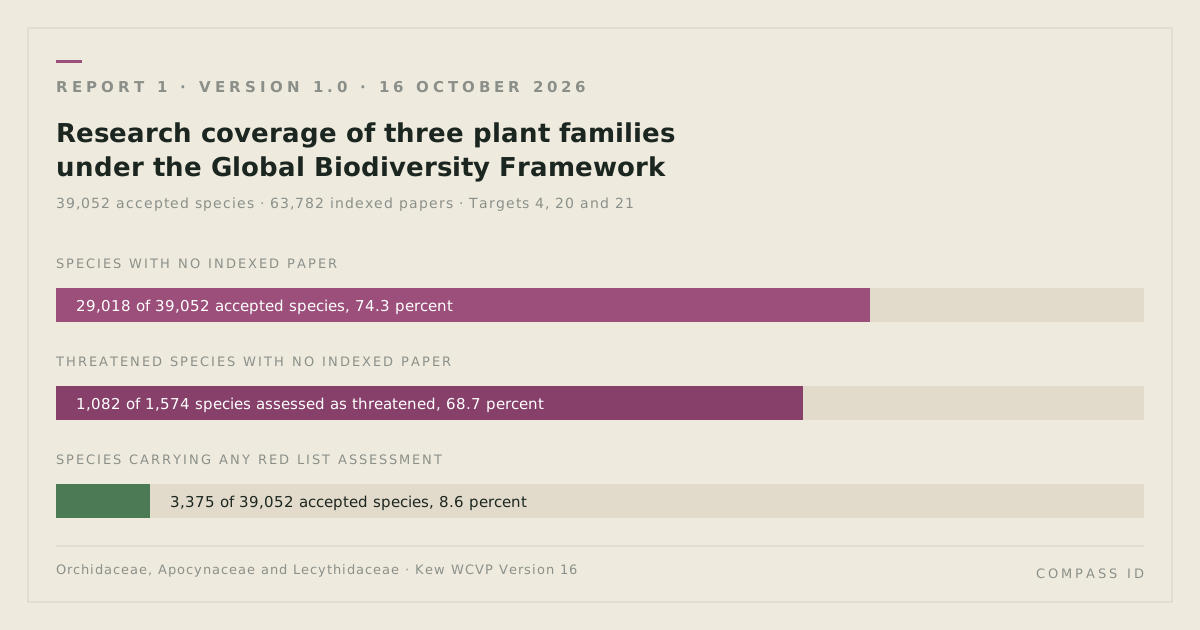
Report 1 of the series Research coverage of the world’s vascular plants, 2026 to 2030, is published for CBD COP17. It counts the indexed research on 39,052 accepted species of Orchidaceae, Apocynaceae and Lecythidaceae against Targets 4, 20 and 21: 29,018 species, 74.3 percent, have no indexed paper, and 14 of 63,782 papers name an instrument of the Convention.
What the report measures
Report 1 is the first instalment of a series that will run to 2030. The denominator is fixed for the whole series: Version 16 of Kew’s World Checklist of Vascular Plants, 365,813 accepted species. This instalment covers three families, 39,052 accepted species, 10.7 percent of the checklist, and the 63,782 indexed papers linked to them. Every accepted name and every name the checklist treats as a synonym was searched in OpenAlex titles and abstracts, and a species with no matched record is reported as having no indexed paper.
A report is not an atlas. The evidence atlases are living pages whose figures are revised whenever the census or the corpus grows. A report is fixed at a version and a date, so that a number quoted from it can be found again. This one is version 1.0, released 16 October 2026, and it carries a dated revision list.
Research coverage against threat status
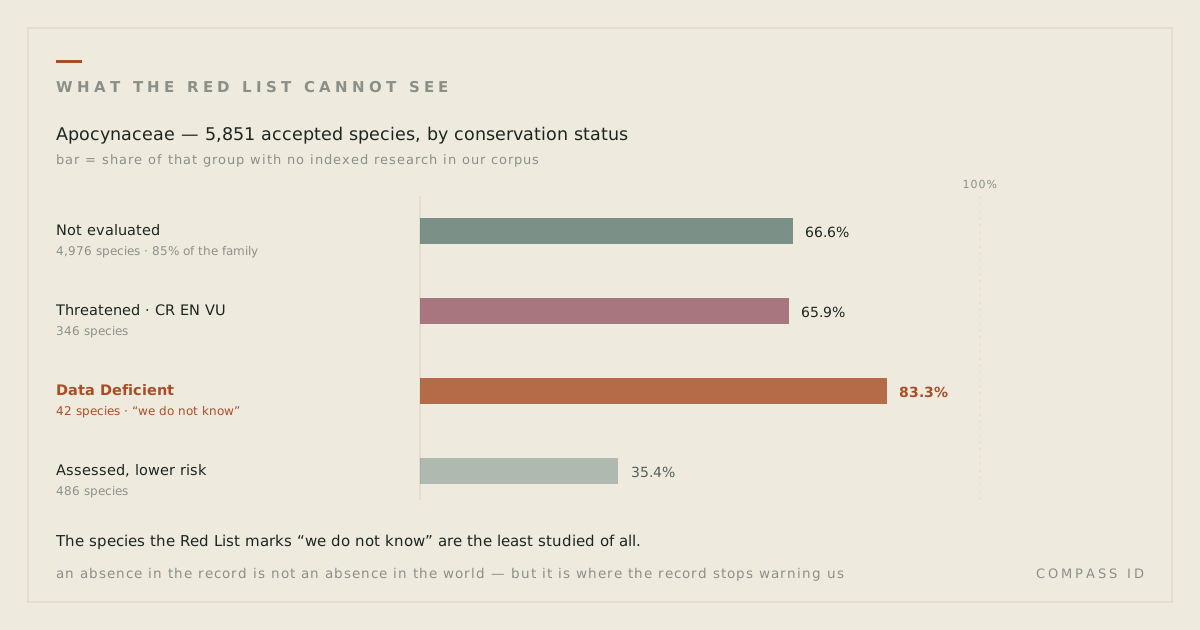
29,018 of the 39,052 species, 74.3 percent, have no paper in the indexed literature whose title or abstract names the species or one of its checklist synonyms. Coverage does not rise with threat. Of 1,574 species assessed as threatened on the IUCN Red List, 1,082 (68.7 percent) have no indexed paper. Of 334 Data Deficient species, the ones whose status could not be decided for lack of information, 279 (83.5 percent) have none, the least covered group of all. Of 1,283 Least Concern species, 617 (48.1 percent) have none.
Assessment coverage is the gap behind the gap. Only 3,375 of the 39,052 species, 8.6 percent, carry any Red List assessment, so the threatened figures describe a known fraction rather than the family. Research that serves Target 4 directly, meaning ex-situ conservation, reintroduction and propagation, species monitoring and Red List assessment, is 1,323 orchid papers (5.0 percent of that corpus), 248 Apocynaceae papers (0.7 percent) and 30 Lecythidaceae papers (0.8 percent).
Where the research happens relative to where the species are
Target 20 concerns capacity and scientific cooperation, and the indexed record carries two things that bear on it: where the fieldwork was done, and where the authors’ institutions are. Of species with known native range countries, 14.3 percent of orchids, 17.5 percent of Apocynaceae and 28.5 percent of Lecythidaceae have at least one located study inside a country they are native to.
The report tabulates all 231 countries. Indonesia, Colombia, Ecuador and Papua New Guinea together hold 19,941 native species of these three families; between 78 and 88 percent of those species have no indexed paper, and between 1 and 7 percent have ever had a located study inside the country. Where fieldwork does happen in the most diverse countries it is often led from elsewhere: in Papua New Guinea 13 of the 16 located studies with recorded author institutions have no institution in the country, and in Madagascar 79 percent. In Brazil, China, India, South Africa and the United States the same share is below 6 percent.
What the indexed literature can and cannot show
Across 63,782 papers, 14 name the CBD, the Kunming-Montreal Framework, the Aichi Targets, the Global Strategy for Plant Conservation, a national biodiversity strategy, or the Nagoya or Cartagena Protocols. Research on these families is conducted almost entirely without naming the policy framework it is expected to inform.
Because papers do not name targets, the report tests a documented crosswalk from the evidence-grounded tags to the 23 targets, and publishes the blind check of it rather than the mapping alone. An independent model, given the target label, the paper and the triggering tag, agreed that the paper contributes to the target in 59 of 60 cases for Target 4 (98 percent), 45 of 60 for restoration and for invasive species (75 percent each) and 43 of 60 for sustainable use (72 percent). The first version of the crosswalk agreed on only 93 of 194 sampled pairs (48 percent, 95 percent interval 41 to 55), and the failures were systematic: a tag describing where or what a paper studies was being read as what the paper is for. The revised crosswalk keeps those mappings in a contributory band only, the report quotes as measured just Target 4, and Targets 16, 18 and 23 are stated to be unmeasurable from research content.
Two limits are stated in the report itself. A count of indexed papers is not a count of knowledge: herbarium specimens, floras, grey literature and the knowledge of local people lie outside it. And indexing is uneven by language. Among Apocynaceae papers with a recorded language, 15.5 percent are not in English; among Lecythidaceae papers, 40.0 percent, 833 of them Portuguese. Part of the apparent gap in Lusophone, Hispanophone and Francophone countries is an indexing gap, and the country table should be read with that in mind.
How the figures are checked
Link precision on this corpus was measured by an adversarial role judge: 84 percent of sampled orchid links are papers that study the species (95 percent interval 78 to 89, on 180 links from 130 species). Tag precision was measured by a blind re-judge of the finished orchid corpus by an independent model: 85.5 percent of 200 sampled tags were confirmed, with a 95 percent interval of 80 to 90. Recall is lower than precision, so counts are more likely under- than over-stated; they are not exact. Every figure in the report is produced by a named script and re-checked against the database before release, and the report lists those scripts and the records they wrote.
Of the 39,052 accepted species in these three families, 29,018 have no indexed paper, 1,082 of the 1,574 species assessed as threatened have none, and 14 of 63,782 papers name an instrument of the Convention.