Indexed research on the orchid family, species by species
The Orchidaceae evidence atlas reads 26,501 indexed studies of the orchid family against Kew’s checklist of 31,892 accepted species. Six genera that are grown, eaten or sold carry two fifths of the research; 24,503 species, 76.8 percent of the family, have no indexed paper.

What the atlas is
The Orchidaceae evidence atlas starts from a census rather than from a search. Every accepted orchid species in Version 16 of Kew’s World Checklist of Vascular Plants, 31,892 of them, is loaded first, together with the 1,953 names the checklist treats as synonyms, and each is then linked to the indexed literature in OpenAlex. A species with no linked paper is recorded as having no indexed paper. The checklist matters because it fixes the denominator: the share of the family with no indexed paper is a count against a published taxonomic authority, not against whatever a search happened to return. The same checklist supplies each species’ native range countries, which is what lets the atlas compare where a species occurs with where it has been studied. The corpus is 26,501 indexed studies, 24,890 of them carrying at least one judge-confirmed tag, 374,745 tags in all.
What the corpus shows
The indexed research on the orchid family is a literature of cultivated plants. Six genera that are grown, eaten or sold, Dendrobium, Gastrodia, Vanilla, Cymbidium, Bletilla and Phalaenopsis, account for 10,752 of the 26,501 studies, 40.6 percent. Dendrobium alone carries 4,696 studies, 17.7 percent of the corpus, more than one study in six. At the other end, 153 of the family’s 728 accepted genera carry no indexed study at all.
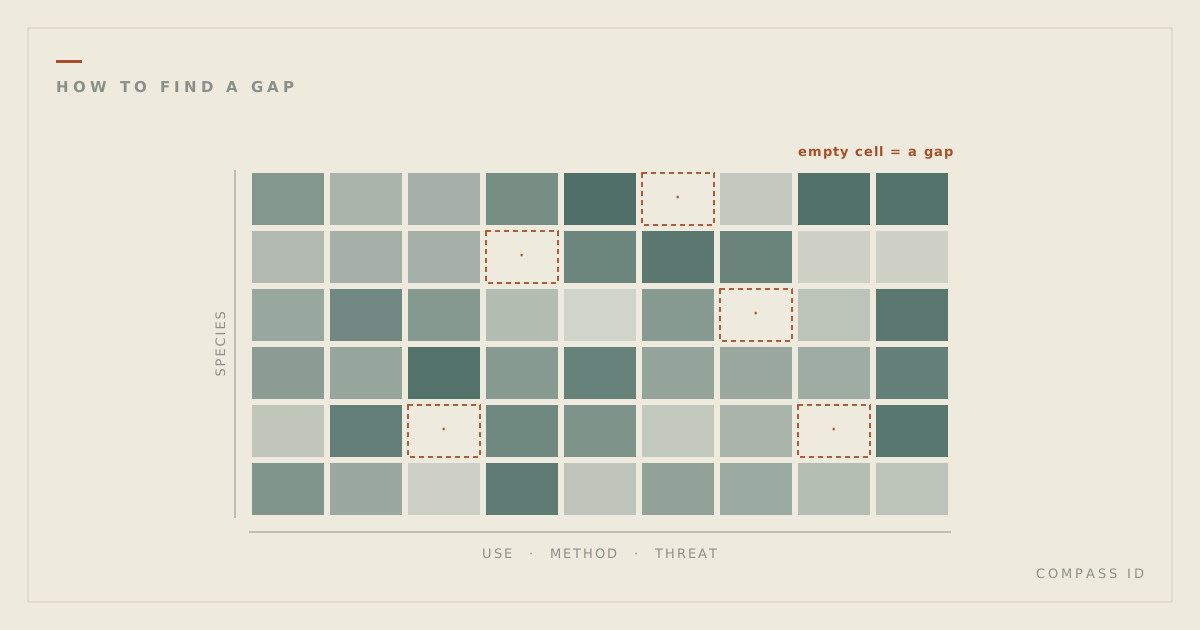
Three quarters of the family has no indexed paper: 24,503 of the 31,892 accepted species, 76.8 percent. The largest genera are the least covered. Bulbophyllum, with 2,220 accepted species, has no indexed paper for 82 percent of them; Stelis, with 1,342 species, for 93 percent. These are candidate gaps, not proof of neglect. Many of these species were described recently, from one or a few collections, in revisions that OpenAlex may index under the genus rather than the species, and a count of indexed papers is not a measure of knowledge. What the count gives is a reproducible floor, species by species, for where the indexed record is silent.
The family-specific tagging shows the same concentration inside the research that does exist. Propagation science is the family’s second-largest research focus, and the new propagation pathway dimension records which route each study took: asymbiotic seed germination, on a sugar medium without the fungus an orchid seed needs in the wild, appears in 1,278 studies, against 409 for symbiotic germination with the fungus, the route that reintroduction depends on. Of the 26,501 studies, 1,463 carry a tag for fungal dependence of any kind, among them 665 on mycoheterotrophs, orchids that take their carbon from a fungus rather than from light. Pollination strategy is stated in 748 studies; 465 of them record a deceptive strategy, in which the flower offers its pollinator no reward. The pharmacology is narrow as well: 5,571 studies record a bioactivity, a compound class or a therapeutic indication, and 3,946 of them, 70.8 percent, concern one of four genera used in Chinese materia medica.
Extinction risk does not redirect the research. Only 2,237 of the 31,892 accepted species carry an IUCN Red List assessment; 29,655 species, 93 percent of the family, are not evaluated. Of the 1,127 species assessed as threatened, 778 (69.0 percent) have no indexed paper, a higher share than among species assessed as Least Concern. Part of this is structural, because the traits that make a species threatened, rarity and a narrow range among them, also make it harder to study. The relationship is a correlation in the indexed record, not a cause.
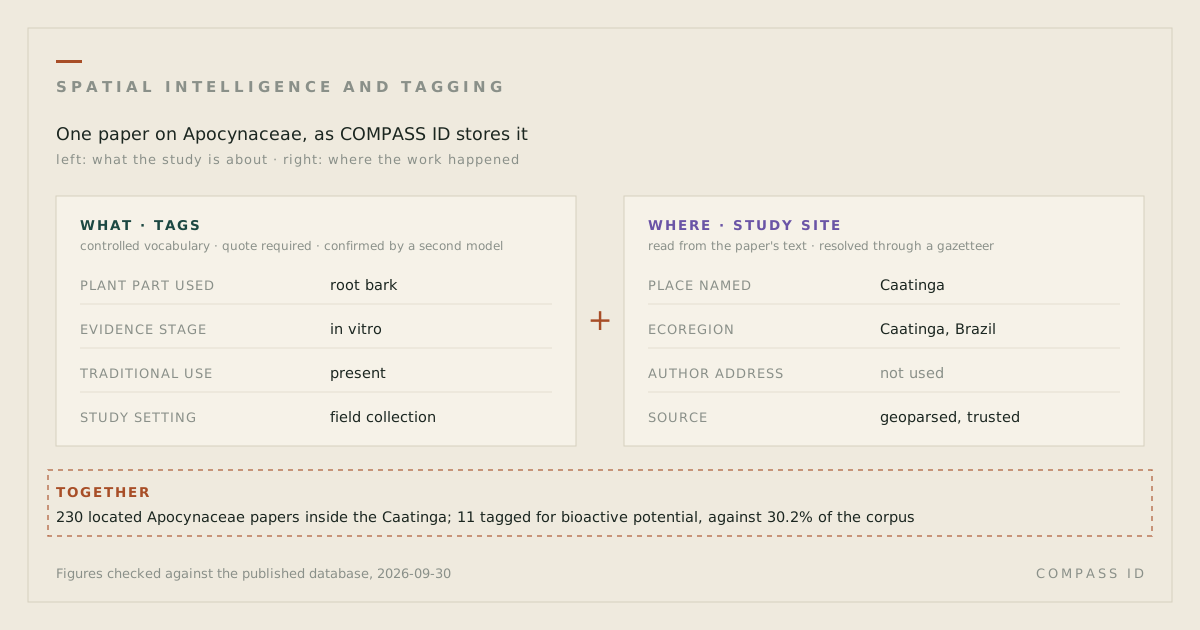
Where the research is and where the species are also differ. Of the 26,501 studies, 6,677 (25.2 percent) name a study site that the geoparser could place, in 150 countries; those sites cluster in China, India and Brazil. The species with no indexed paper are concentrated in Indonesia, the northern Andes and New Guinea, the centres of orchid diversity. Set each species’ range against its study sites and the picture is this: of the 31,777 species with known range countries, 4,547 (14.3 percent) have a located study site inside one of them.
What is new in the method since the Apocynaceae atlas
Four things changed between the Apocynaceae atlas and this one. The tag precision figure now comes from a blind re-judge of the finished corpus by an independent model, not from the build-time gate alone: on 200 sampled tags it was 85.5 percent, with a 95 percent interval of 80 to 90. Recall is lower than precision, so counts are more likely under- than over-stated; they are not exact. Study-site coordinates pass through a guarded, reversible hardening pass after geoparsing, and placements the pass could not confirm are kept in the database but not plotted; the atlas plots only the 6,677 hardened sites. Species ranges now come from the Kew checklist’s own distribution table rather than from occurrence records, so the in-range test uses the same authority as the census. And the atlas carries a beta section that models how much located research each ecoregion and administrative region would be expected to have, given its area, species richness, access, environmental change and national research effort, and ranks the places that fall short of it. That model is a first attempt: its cross-validated pseudo-R2 is 0.55 for ecoregions and 0.54 for administrative regions, and a unit with less research than expected is a candidate gap, never proof of neglect. The geoparsing itself still rests on a 40-site manual check that found 31 plausible; a larger human check is planned.
How to use it
The atlas is organised as sections that each answer one question. Section 02 gives the concentration on cultivated genera, section 03 the propagation routes, section 04 the pharmacology and section 05 pollination and fungal dependence. Section 06 lists the species with no indexed paper genus by genus, section 07 crosses that with IUCN status, and section 09 sets study sites against species ranges, country by country. Section 11 is the expected-research beta. The interactive map plots the same study sites with the orchid layer switched on, lets you filter them by the atlas’s own tags, country and year, and reads the papers behind any cluster; the coverage and range-shortfall layers shade each country by the share of its range species with no study site inside it.
Of the 31,892 accepted orchid species in Kew’s checklist, 24,503 have no indexed paper, and six cultivated genera account for 40.6 percent of the 26,501 indexed studies.