What we miss when a species has no indexed research
Dark extinction is the loss of species nobody ever named. By definition it cannot be counted directly. What can be counted is the antechamber: species we have named, and then never looked at again. In one medicinal plant family, the species the Red List marks “Data Deficient” turn out to be the least researched of all.
There is a category of loss that leaves no record. A species exists, its habitat is cleared, and it goes extinct without ever having been collected, named or described. Nothing enters the Red List, because there is no name to enter. Botanists and zoologists call this dark extinction, and the term is not rhetorical. It names a measurable quantity that has to be estimated rather than observed.
Boehm and Cronk laid out the problem in 2021 and applied statistical methods to birds, the best-catalogued class on Earth: roughly 56 dark extinctions in the taxonomic period since 1800, and around 180 more in the pre-taxonomic period from 1500 to 1800, losses that occurred as ships carried rats and goats to islands whose species nobody had yet written down. Tedesco and colleagues put undiscovered extinctions at between 15% and 59% of all extinctions, depending on the group and region.
Why the official count is so small
Set that against the headline figures. We are said to be entering a sixth mass extinction; Ceballos and colleagues argued in 2015 that even the most conservative estimates put modern extinction rates far above background, and rising.
Yet the official ledger is almost empty. Régnier and colleagues pointed out the paradox precisely: of roughly 1.9 million known species, only 799, or 0.04%, are formally recorded as extinct. Extrapolating from a random sample of land snails, they estimated that we may already have lost around 7%, or 130,000 species. The gap between 799 and 130,000 is not a disagreement about biology. It is the distance between what has been assessed and what has happened, and it exists because the status of very few invertebrates, which are the bulk of life, has ever been evaluated.
That is the sentence to sit with. Extinction is recorded only where someone was looking. An assessment requires evidence, evidence requires study, and study is distributed very unevenly. Hortal and colleagues catalogued seven distinct shortfalls in what we know about biodiversity, from the Linnean shortfall in which species remain undescribed, to the Wallacean shortfall in which described species have unknown distributions. Dark extinction is what happens when the first of those shortfalls meets a bulldozer.
The part we can actually count
COMPASS ID cannot measure dark extinction. Nobody can measure it directly; that is what makes it dark. What we can do is measure the layer immediately above it, which has been much less discussed and is entirely countable: species that science has named, and for which no indexed research exists.
Our method is to load every accepted species in a group from a taxonomic authority, then match each one against the indexed literature. A species with no linked paper is not an estimate or a model output. It is a species for which our search of the indexed record returned nothing.
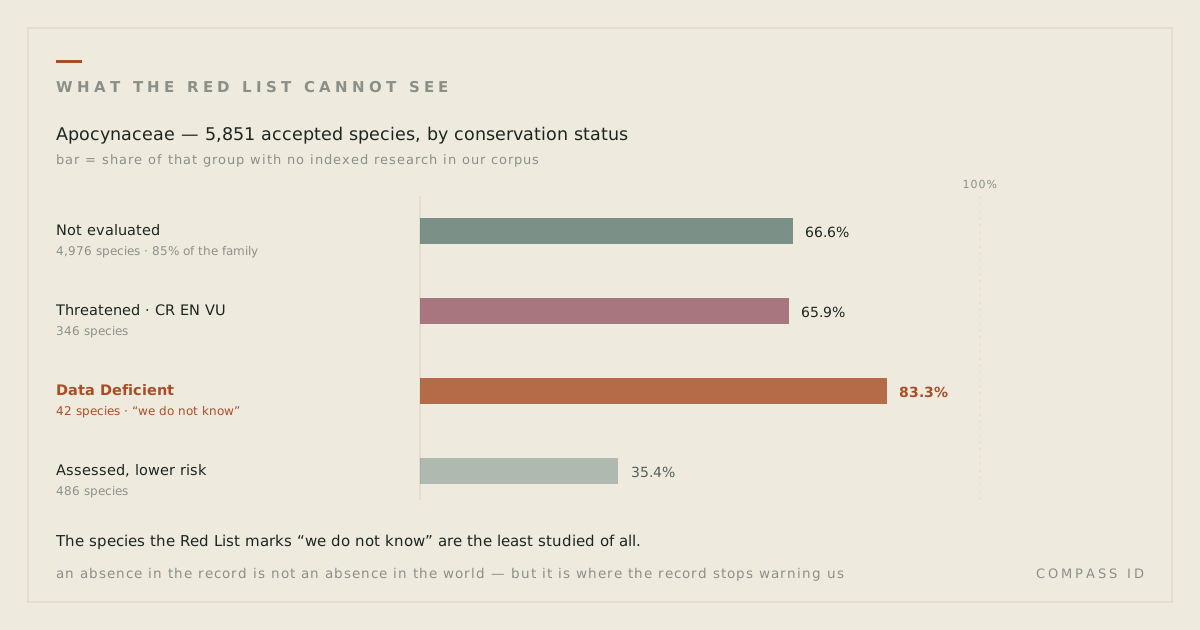
For Apocynaceae, the dogbane and milkweed family that gave medicine vincristine and reserpine, the census is 6,759 accepted species, those accepted in Version 16 of Kew’s World Checklist of Vascular Plants. 4,292 of them, 63.5%, have no indexed research at all. Breaking that down by conservation status is where it becomes uncomfortable:
| IUCN status | Species | No indexed research | Share |
|---|---|---|---|
| Not evaluated | 5,884 | 3,859 | 65.6% |
| Threatened (CR, EN, VU) | 346 | 227 | 65.6% |
| Data Deficient | 42 | 35 | 83.3% |
| Assessed, lower risk | 486 | 170 | 35.0% |
| Extinct | 1 | 1 | 100% |
Four things fall out of that table.
Most of the family has never been assessed at all. 5,884 of 6,759 species, 87%, carry no IUCN assessment. Whatever is happening to them is happening off the ledger, in exactly the way Régnier described for invertebrates.
Being flagged as threatened has not brought research with it. Species assessed as Critically Endangered, Endangered or Vulnerable have no indexed research at 65.6% (95 percent Wilson interval 60.5 to 70.4), against 65.6% (64.4 to 66.8) for species that have not been evaluated; the difference is not significant (chi-square below 0.01, p = 0.99). A Red List listing is supposed to be a signal to act. In this family it has not translated into a literature.
“Data Deficient” is the worst-served category of all, at 83.3%. This is the tightest loop in the table. Data Deficient means the assessors could not find enough evidence to judge the species’ risk. Four in five of those species then have no indexed research to supply that evidence. They were labelled unknown because nobody had studied them, and they remain without indexed research because nothing about the label creates a reason to. A species can sit in that loop indefinitely, and if it disappears while it is there, it disappears without ever having been assessed, which, from the ledger’s point of view, is nearly indistinguishable from dark extinction.
By contrast, species assessed as lower-risk are the best-studied group, at 35.0% with no indexed research. We would read that carefully rather than dramatically: a species is usually assessable because somebody had already looked at it. That is a bias in why people looked, not proof that low risk causes research.
And there is one species in the Extinct row. Ochrosia kilaueaensis, known as holei or Hawai‘i yellowwood, was a tree of fifteen to eighteen metres, endemic to the island of Hawai‘i, collected at Pu‘u Wa‘awa‘a and Kīpuka Puaulu, and not seen since the 1940s. The IUCN lists it as Extinct. Our corpus has no indexed research on it at all.
It is worth being clear about what that single row does and does not show. It is not dark extinction: the species was named, collected, and formally assessed, so it is on the ledger. But it is the nearest thing to it that a record can hold: a plant that entered the taxonomy and left the world with nothing in the indexed literature in between. Whatever it knew how to do chemically, in a family that has already given medicine two major drugs, went with it.
What this is and is not
We want to be exact about the size of this claim, because the subject invites overstatement.
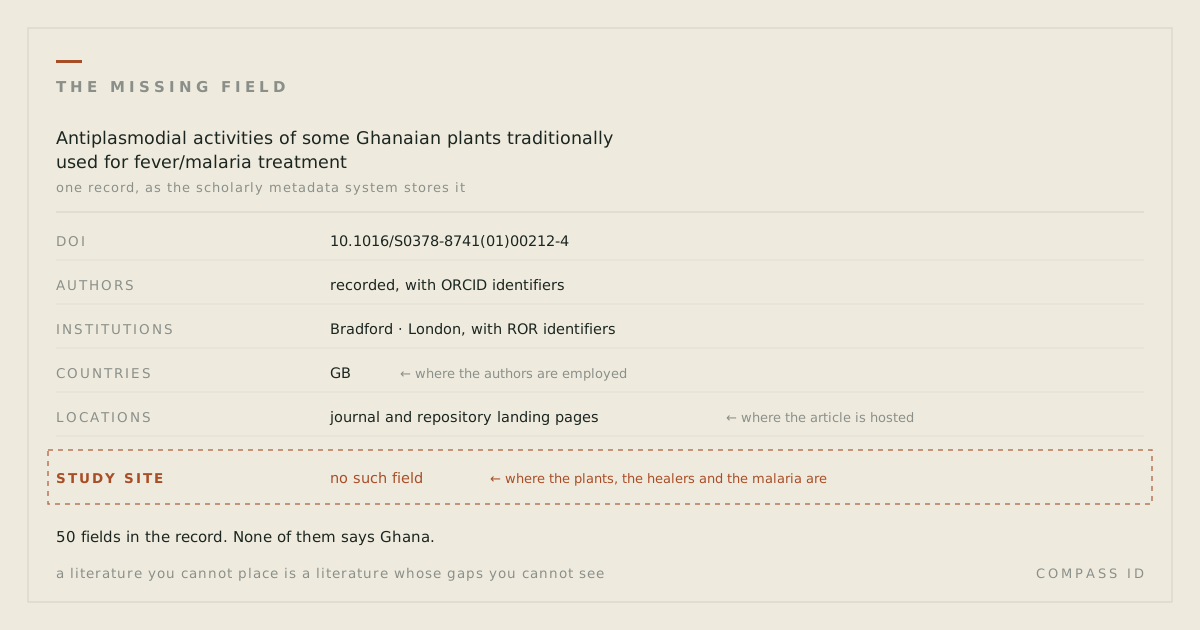
“No indexed research” is not “never studied.” It means our search of the indexed literature found nothing linking that species to a paper. Work published in a journal no index covers, in a language or a national record outside the major databases, or in a herbarium note that never became an article, will not appear. Every blank on our maps and in our counts says no indexed research, and we will not write the stronger sentence.
It is also not a claim about extinction. A species with no indexed research is not a lost species. The link is narrower and, we think, more useful: a species with no literature cannot be assessed, an unassessed species cannot be protected on the evidence, and a species lost while unassessed leaves no trace in the record that is supposed to tell us how bad things are.
And the machinery is fallible. The species-to-paper links behind these counts are built by an automated pipeline and measured rather than assumed: in a small audit (28 links, one family) 89 percent of linked papers studied the species as a subject, the rest mention it; we report tag precision and recall for the Antarctic and desertification atlases and are adding them to the others. Errors in both directions exist.
Why bother counting the antechamber
Because unlike dark extinction, it is actionable. You cannot go and study a species nobody has named. You can absolutely go and study Apocynaceae species number 4,292. It has a name, a type specimen, a known range, and a Red List row recording that nobody knows. The list of such species is finite, it is enumerable, and we can hand it to you sorted by how threatened the species is and how little is known.
That is what an evidence atlas is for. Not to announce a crisis, which is already well announced, but to convert a general anxiety about what we are losing into a specific, checkable list of what nobody has looked at yet, while looking is still possible.
Sources
- Boehm, M.M.A. & Cronk, Q.C.B. (2021). Dark extinction: the problem of unknown historical extinctions. Biology Letters 17(3): 20210007. doi:10.1098/rsbl.2021.0007
- Tedesco, P.A. et al. (2014). Estimating How Many Undescribed Species Have Gone Extinct. Conservation Biology 28(5): 1360–1370. doi:10.1111/cobi.12285
- Régnier, C. et al. (2015). Mass extinction in poorly known taxa. PNAS 112(25): 7761–7766. doi:10.1073/pnas.1502350112
- Ceballos, G. et al. (2015). Accelerated modern human–induced species losses: Entering the sixth mass extinction. Science Advances 1(5): e1400253. doi:10.1126/sciadv.1400253
- Hortal, J. et al. (2015). Seven Shortfalls that Beset Large-Scale Knowledge of Biodiversity. Annual Review of Ecology, Evolution, and Systematics 46: 523–549. doi:10.1146/annurev-ecolsys-112414-054400
Figures updated 3 October 2026 to the Kew WCVP Version 16 census (6,759 accepted species, 4,292 with no indexed research); see the atlas revision note.