Indexed research on the coffee family, species by species
The Rubiaceae research atlas reads 41,317 indexed studies of the coffee family against Kew’s checklist of 14,400 accepted species. Three quarters of the family has no indexed paper, and one genus holds a third of the research.

What the atlas is
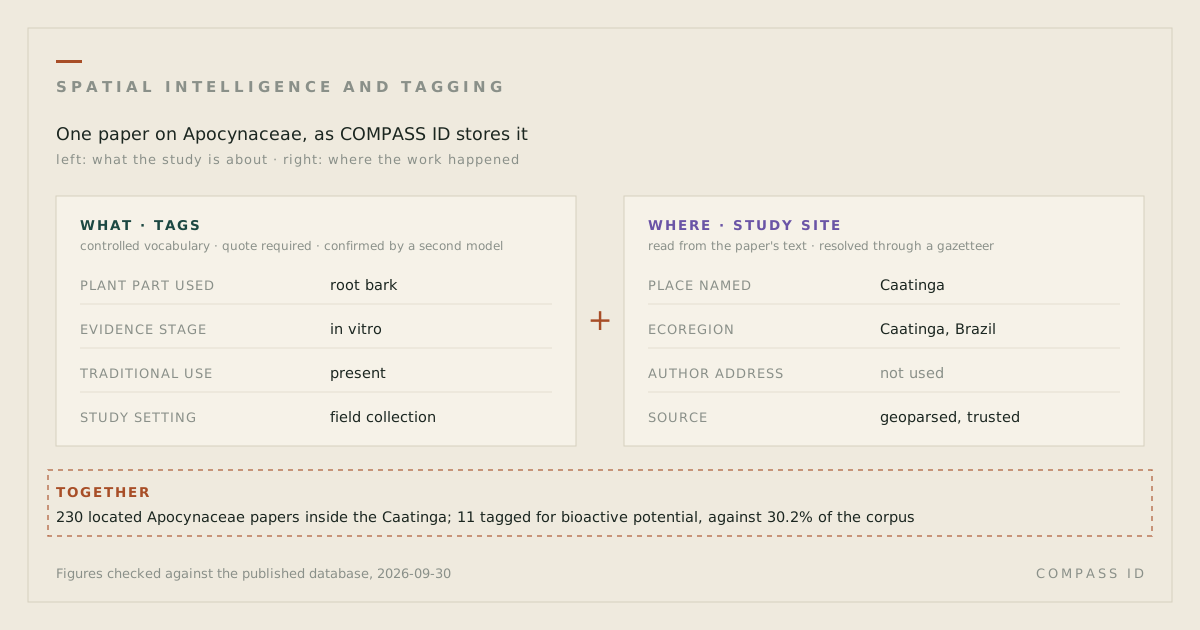
The Rubiaceae research atlas starts from a census rather than from a search. Every accepted species in Version 16 of Kew’s World Checklist of Vascular Plants is loaded, each is linked to the indexed literature under its scientific name and the names the checklist treats as synonyms, every study is tagged against a 52-dimension codebook by a panel of domain-expert models with a second model checking each tag, and every study that names a field site is placed at that site rather than at its authors’ address.
The Rubiaceae are the fourth largest family of flowering plants and the largest corpus this series has measured: 14,400 accepted species and 41,317 indexed studies.
What the corpus shows
Three quarters of the family has no indexed paper. 3,597 species, 25.0 percent, have at least one; the remaining 10,803 have none. That share is close to the orchid family’s, but it arrives a different way. The orchids are a very large family studied thinly and evenly. The Rubiaceae are a very large family in which one crop has absorbed most of the attention.
The genus Coffea accounts for 14,298 studies, 34.6 percent of the family’s whole indexed record. Almost all of it sits on two species: Coffea arabica with 10,811 studies and Coffea canephora, robusta, with 3,953. The five most studied genera carry 61.0 percent of the corpus between them and the twenty most studied carry 83.7 percent, and every one of those genera is economically useful.
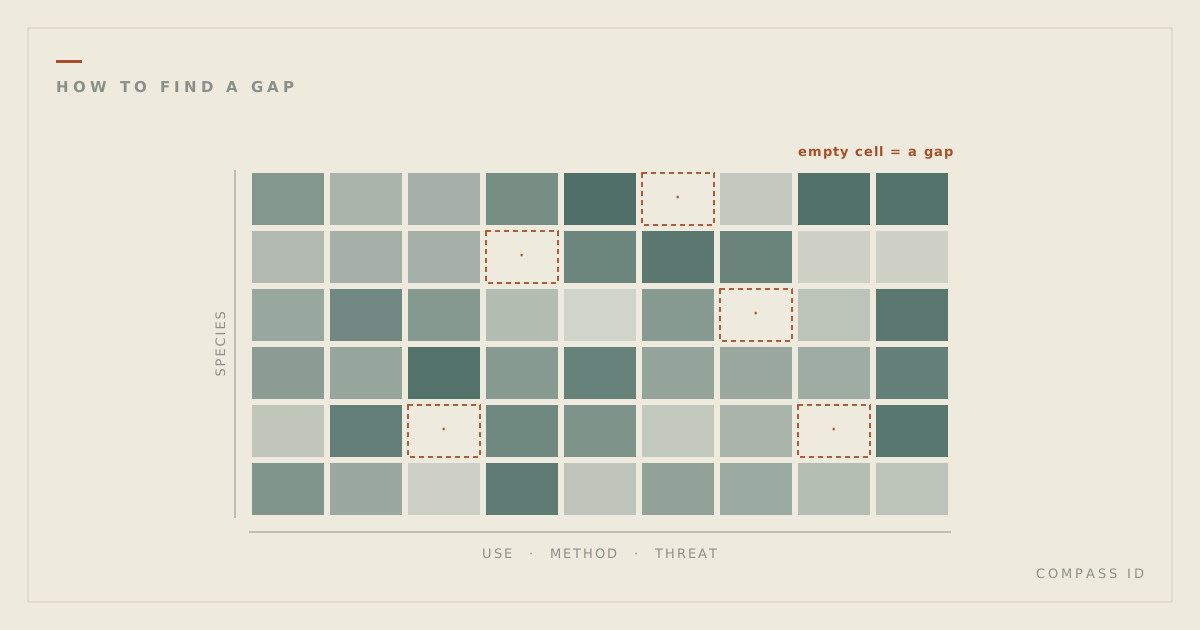
The figure worth pausing on is inside the coffee genus itself. 74 of the 134 accepted Coffea species, 55 percent, have no indexed paper. These are the crop’s wild relatives, most of them narrow endemics of Madagascar, the Mascarenes and West Africa, and they are the pool that coffee breeding will have to draw on for heat tolerance and disease resistance. The cultivated species are among the most studied plants on earth; the genus they belong to is not.
At the other end of the family, Psychotria is the largest genus in the Rubiaceae and one of the largest genera of flowering plants anywhere, with 1,645 accepted species. It carries 835 studies, 2.0 percent of the corpus, and 1,385 of its species, 84 percent, have no indexed paper. Palicourea, the second largest at 706 species, has 432 with none.
Two smaller cases are worth naming because they are usually assumed to be larger. Kratom, Mitragyna speciosa, carries 1,034 studies on its own, a recent and almost entirely pharmacological literature. Cinchona, the source of quinine and the reason this family was economically important for three centuries, carries 353 studies, 0.9 percent of the corpus. The history is larger than the current science.
Research against extinction risk
4,345 species, 30.2 percent of the family, carry an IUCN Red List assessment. Among those assessed as threatened, 1,477 have no indexed paper, and 290 of those are Critically Endangered: species judged to be at the highest risk of extinction for which the indexed literature holds nothing at all. That is the clearest actionable list the atlas produces, and it is a list of names rather than a statistic.
Where the research happens
10,228 of the 41,317 studies, 24.8 percent, name a study site the geoparser could place, across 170 countries. Brazil leads with 2,512, then Indonesia with 1,259, India with 572 and Ethiopia with 426. That ordering is a coffee map as much as a Rubiaceae map. Ethiopia is the exception that proves the point, because it is where Coffea arabica is native and where its wild populations are worked on. Map instead where the species with no indexed paper occur, and a different geography appears: the forest floras of Madagascar, New Guinea, Borneo and tropical West Africa.
How the figures were checked
Tag precision was measured by a third model that never acted as tagger or judge, shown the paper, the dimension, the stored evidence span and the codebook rubric, and asked to confirm or reject without being told the tag had already been confirmed. It confirmed 178 of 200 sampled tags, 89.0 percent, with a 95 percent interval of 83.9 to 92.6 and no tag left unjudged. Read separately, the coffee half of the corpus measures 87.9 percent and the rest of the family 89.6 percent, so the crop literature is not carrying the figure.
Two limits on that number are stated on the atlas page rather than left implicit. It is measured on the abstract-bearing corpus only, because the sampling rule needs an abstract to show the judge, so 50,669 of the 640,292 tags, 7.9 percent, sit on title-only papers and are outside the instrument. The same exclusion applies to every accuracy figure this platform publishes. And 5,679 tags, 0.93 percent of those written under this codebook version, are refusal pass-throughs: tags the judging model declined to rule on, concentrated in the kratom and Uncaria psychoactive and toxicology literature. They are stored and counted rather than dropped.
Link precision was measured by an adversarial role judge on 179 sampled links from 130 species: 85 percent are papers that study the species, 24 of 179 name it without studying it and 3 are unrelated.
How to use it
The atlas is organised as sections that each answer one question. Section 02 reads coffee as its own stratum. Section 03 sets research against species richness genus by genus. Section 04 sets it against Red List category. Section 06 puts the study sites against species ranges, and section 07 sets the same sites against forest loss and the aridity trend. The interactive map plots every located study and lets the corpus be filtered by any of the atlas tags.
Of the 14,400 accepted Rubiaceae species, 10,803 have no indexed paper, and 74 of the 134 species in the genus that carries a third of the research have none either.