Indexed research on the amphibians, species by species
The amphibian research atlas reads 65,133 indexed studies of frogs, salamanders and caecilians against AmphibiaWeb’s taxonomy of 9,014 species. Two fifths of the class has no indexed paper, and fourteen laboratory, farmed and commodity species are linked to more than a quarter of the research.

What the atlas is
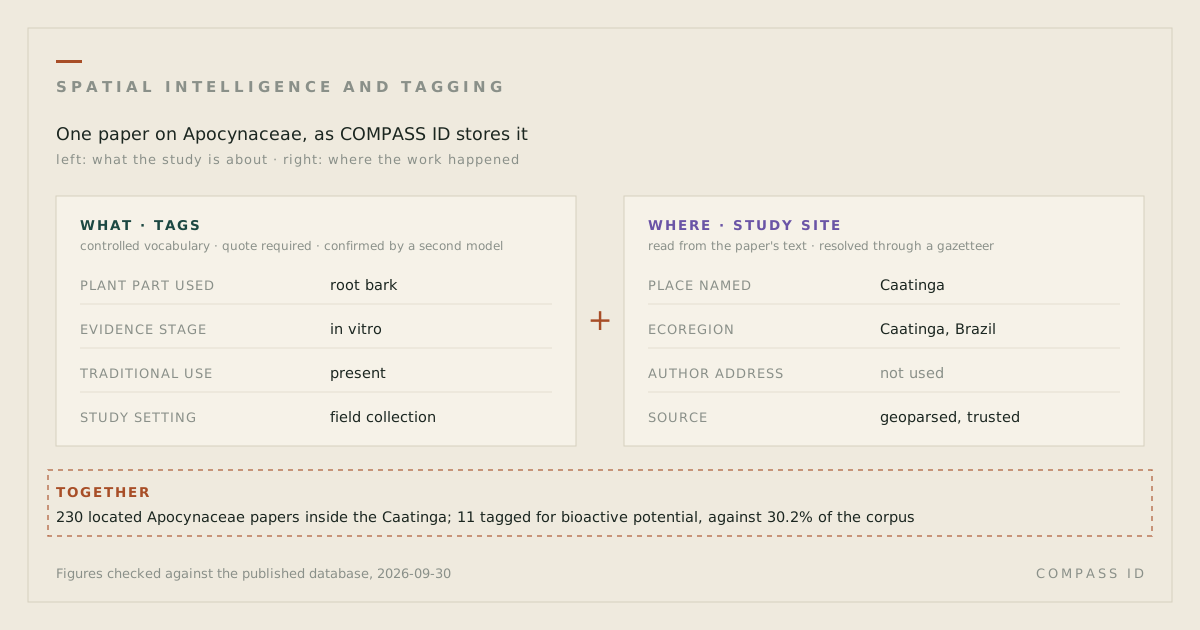
The amphibian research atlas starts from a census rather than from a search. Every species in AmphibiaWeb’s taxonomy snapshot of 1 April 2026 is loaded, each is linked to the indexed literature under its scientific name, its listed synonyms and its Red List name, every study is tagged against a 58-dimension codebook by a panel of models whose tags a second model checks, and each study is placed at its field site rather than its authors’ address. The census is AmphibiaWeb’s rather than Amphibian Species of the World’s because both websites refused automated download and AmphibiaWeb publishes its taxonomy as an open monthly snapshot.
It is the first atlas in this series that covers a whole class rather than one family: 9,014 species in 77 families and three orders, and 65,133 indexed studies.
What the corpus shows
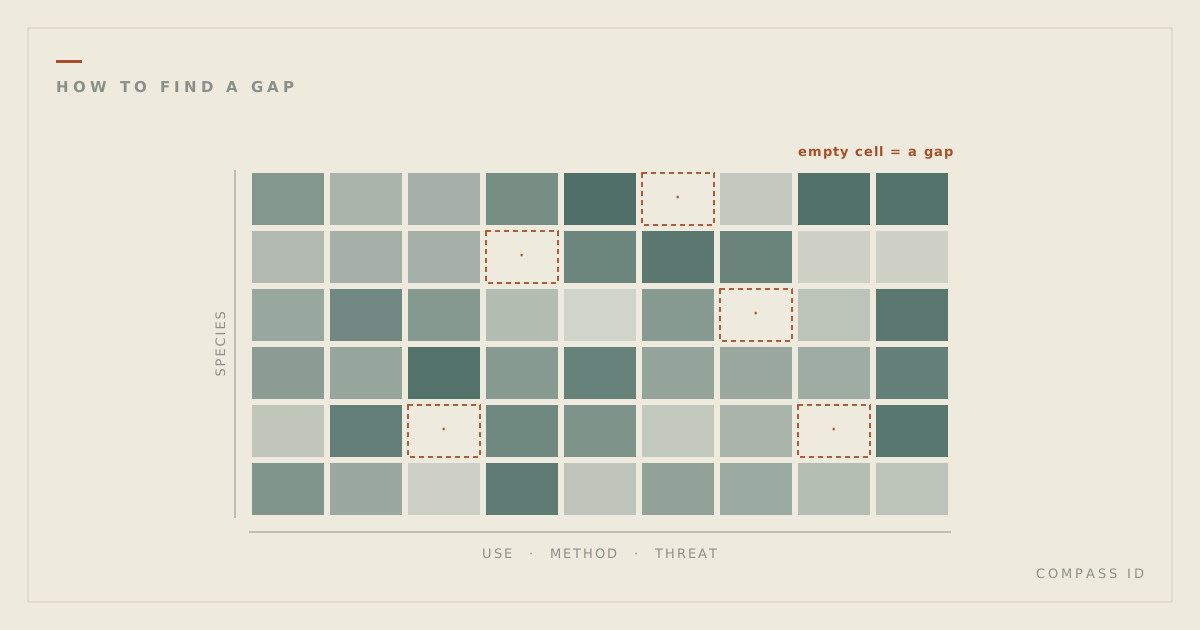
5,495 species, 61.0 percent, have at least one indexed paper; the remaining 3,519 have none. The share is similar across the three orders: 3,151 frogs and toads, 274 salamanders and 94 caecilians have no indexed paper.
A large part of the literature is not field research on wild animals. The clawed frogs of developmental biology, the axolotl and the eastern newt of regeneration research, the bullfrog, the leopard frog, the common frog and the common toad of the teaching laboratory, a farmed giant salamander and a toad harvested for a traditional medicine: these fourteen species are linked to at least 18,363 studies, 28.2 percent of the corpus. For seven of them the harvest stopped at the first 2,000 works per name, because their literatures run to tens of thousands of papers (OpenAlex reports 28,915 works for the name Xenopus laevis alone), so their counts are lower bounds. The atlas reports them as their own stratum and removes nothing from any denominator.
The species with no indexed paper sit elsewhere. The rain frogs, Strabomantidae, are the second largest amphibian family with 824 species, and 437 of them have no indexed paper; the family carries 629 studies, 1.0 percent of the corpus.
Research against extinction risk
Amphibians are among the most completely assessed groups on the Red List: 7,984 species, 88.6 percent of the class, carry a category. Among those assessed as threatened, 1,277 have no indexed paper, and 429 of those are Critically Endangered, more than half of the 818 Critically Endangered amphibians. The axolotl is Critically Endangered too, and carries 1,353 studies, almost all of them on laboratory colonies; the atlas shows both numbers.
Disease is the threat that set amphibian conservation apart: 1,457 studies name the chytrid fungi in the title or abstract.
Where the research happens
17,250 of the 65,133 studies, 26.5 percent, name a study site the geoparser could place, across 199 countries. The United States leads with 3,377, then Brazil with 2,364 and China with 847. The species with no indexed paper are concentrated elsewhere: counted by the countries where AmphibiaWeb lists them as native, Papua New Guinea has 339, Colombia 297 and Ecuador 273.
How the figures were checked
Tag precision was measured twice by a third model that never acted as tagger or judge, on two independent draws of 120 tags each: 100 of 120 confirmed (83.3 percent) and 96 of 120 (80.0 percent), both above the platform floor of 79.8 percent. The measurement covers the abstract-bearing corpus only, so 8.0 percent of the tags, those on title-only papers, are outside the instrument; the atlas page states this. Link precision was measured by an adversarial role judge on 317 sampled links from 200 species: 91 percent are papers that study the species.
How to use it
The atlas is organised as sections that each answer one question. The laboratory section reads the fourteen flagged species as their own stratum. The family section sets research against species richness family by family, and the Red List section sets it against extinction risk. The spatial section puts the study sites against species ranges. The interactive map plots every located study and lets the corpus be filtered by any of the atlas tags.
Of the 9,014 amphibian species, 3,519 have no indexed paper, and 429 of them are Critically Endangered.